Liquid democracy > Representative democracy
It's not the 18th century anymore

When the United States celebrates its 250th birthday in 2026, the milestone will be a perfect moment to reflect on what’s working—and what’s not. One of the things that clearly isn’t working anymore is representative democracy. This is the idea that various geographic areas, often laid out in ways that predetermine the party affiliation of the winners, should have a person who represents the policy interests of all the inhabitants for a fixed period of time.
Representative democracy was better than what it replaced—monarchy—and appropriate for a time when interstate communication and travel were very slow. In the 18th century, it was impossible for citizens to stay current with the work of the national legislature. An elected representative could travel to the capitol and make informed decisions on behalf of his constituents.
Representative democracy was functional when America was young; almost everyone lived on farms and political participation was limited to white men. Today’s electorate is far more diverse in both occupation and identity, and also more polarized. For many citizens whose preferred candidate loses, they are sentenced to years of representation by those they oppose.
Liquid democracy is the 21st century solution.
Representative democracy: It’s all gerrymandering
Gerrymandering has been in the news recently, with several states redrawing their districts in order to “predetermine the party affiliation of the winners.” Polls show the public disapproves of this practice; it upsets our basic sense of fairness. Just because a given distribution is blatantly wrong, however, we should not conclude that there is a correct alternative.
To better understand why, and to demonstrate how liquid democracy could work, let’s walk through a simple scenario. Imagine a territory where 15 constituents, nine who support the yellow team and six who support the purple team, will elect five representatives to the territory’s legislature. Which of these is the “correct” map?
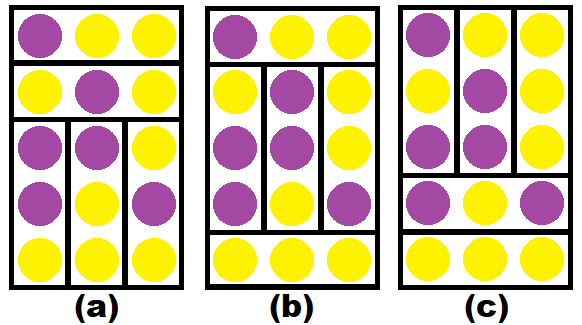
From a top-down perspective, it might seem reasonable that since 3/5ths of the constituents are yellow, 3/5ths of the legislators ought to be—and it is very reasonable! But to ensure that proportion, mapmakers must “predetermine the party affiliation of the winners,” and reject (a) and (c).1 But before we congratulate ourselves for recognizing (b) as the “correct” answer, let’s consider three more.
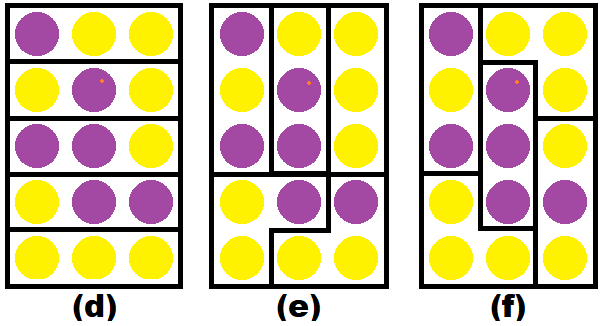
Is one of these maps more fair than others? Consider the purple dot with the orange speck. To get to the reasonable outcome of having purple holding a majority in exactly two districts, mapmakers must predetermine whether that constituent will be (d) a minority in their district, with little influence on a yellow representative; (e) part of a majority, with some influence on a purple representative; or (f) be in an all-purple district, where they might help the candidate advocating the most extreme purple policies win.
There is no “correct” answer under representative democracy.
Gerrymandering is inherent in representative democracy, because elections in the United States are winner-take-all. (Put another way, elections are a zero-sum game.) This is why representative democracy continues to fail us.
What is liquid democracy?
In short, liquid democracy allows constituents to delegate their representation—give a proxy—to any person serving in the legislature, instead of it being automatically assigned based on their geographic location. In the legislative body, delegates’ voting strength then varies based on how much power others have given them.2
Consider the gerrymandered map (c) that gave the minority purple team a 3-2 majority in the legislature. With liquid democracy, yellow voters can transfer their power to yellow team legislators in another district. The three purple legislators might then represent two constituents each, while the two yellow legislators represent four and five. This delegated authority translates into voting power in the assembly—when divisive policies comes up for a vote, the yellow majority will win, 9-6.
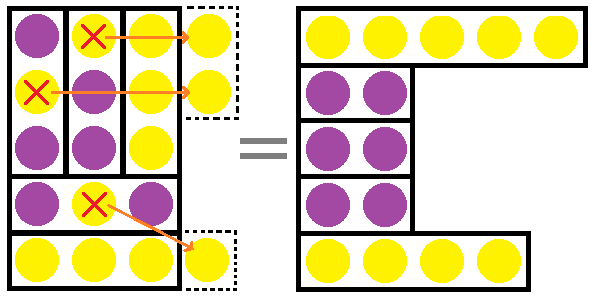
Gerrymandering becomes nearly irrelevant under liquid democracy.
Transfer any time
One of the reasons gerrymandering is so desirable for the red team and blue team is that representatives are elected for 24-month terms,3 with the maps traditionally reused for a whole decade. Rigging one map can lead to winning thousands and thousands of legislative votes.
For many citizens whose preferred candidate loses, they are sentenced to years of representation by those they oppose.
With liquid democracy, constituents can reassign their proxy each month. If they don’t like how their vote is being used, their power can flow to where it will better align with their policy preferences. Unlike representative democracy, there is no years-long commitment, keeping delegates continuously accountable to their constituents.
Share the power
Proxies can also be divided into fractions—60%, 25%, 14%, 1%, for example—to distribute an individual’s power among multiple delegates to match their different priorities. Doing so allows them to be able to appeal to more than one legislator as a constituent on important issues. Imagine that four people transfer 75% of their voting power to other delegates, like so:
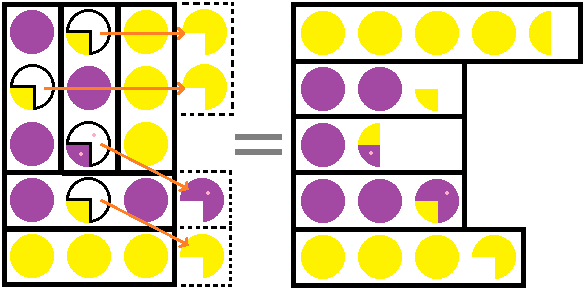
It also enables the purple voter with the pink dots to hedge their vote, perhaps shifting some of their power from a fringe legislator to a more moderate delegate. This hedging means that if their proxies are cast in ways that cancel each other out, a constituent’s net influence will be less than their full vote.
Will parties develop under such a system?
The 1787 Constitution contains no mention of parties because the Framers hoped they would be unnecessary. Elections would be conducted rationally and logically, without the rancor of partisanship. They were so confident that they even assigned the office of vice president to the second-place presidential candidate! But even before the 18th century drew to a close, the Federalists and anti-Federalists had formed national coalitions.
I believe that by making power so liquid, it will be harder to accumulate in the legislature. Since elections would no longer be winner-take-all (the winner only gets as much as their constituents give them), liquid democracy seems more likely to support a multiparty system, one with shifting coalitions. However, to ensure that control of the legislative machinery remains with the constituents, there is one more fail-safe: Individuals may withdraw their proxies and wield their tiny sliver of power directly and fully.
A 21st century upgrade for politics
Too many people these days treat elections and politics as synonyms. They’re not. Politics is about setting policy. The whipsaw nature of our national elections (driven in part by anti-incumbent bias) has spilled over into policy setting, where the side winning a majority reverses what the previous majority did. This uncertainty only adds to the stakes and the stress of elections.
Liquid democracy would have a calming effect; the nation’s collective opinions do not swing as dramatically as control of Washington does. While elections will always have consequences, we’ve come a long way since the 18th century. Individuals around the country can communicate and collaborate on the issues of the day in real time. Granting individuals exclusive representation for large geographic areas is no longer required to produce a functional democracy, and may even be counterproductive.
When the United States celebrates its 250th birthday in 2026, the milestone will be a perfect moment to question what we can do better in the future. Liquid democracy is just one answer; add your own in the comments below.
Another possibility is sortition—selecting citizens randomly to serve, much like jury duty. It could produce a body that mirrors the broader population without being distorted by campaigning, elections, or special interests. But sortition has its own set of challenges, including economic inequities which mean that many people can’t afford to serve. For my purposes, though, a truly random sample would almost certainly require government cooperation, whereas a voluntary assembly using liquid democracy can be launched in 2026—without waiting for permission from Congress or anyone else.
There are different flavors of liquid democracy; the descriptions here are based on the structure described in my novel, Looking Backward from the Tricentennial. (Chapter 20 talks about liquid democracy.) I am proposing a Populists’ Legislative Assembly in 2026, to refine federal legislation advancing populist policy. Constituents must be American citizens, make a good-faith pledge to vote the Populist Fusion slate on November 3, 2026, and contribute at least twenty-five cents a day; delegates have slightly higher requirements. (Constituent application)
There are rare exceptions; New Jersey has terms of up to four years in their legislature.